When Control Is Mistaken for Parenting
A recent exchange on X (Twitter) perfectly illustrates how authoritarian control is still being framed as “strong parenting” by a certain online subculture. What’s being celebrated here isn’t guidance, protection, or responsibility; it’s insecurity, ego, and fear masquerading as moral authority.
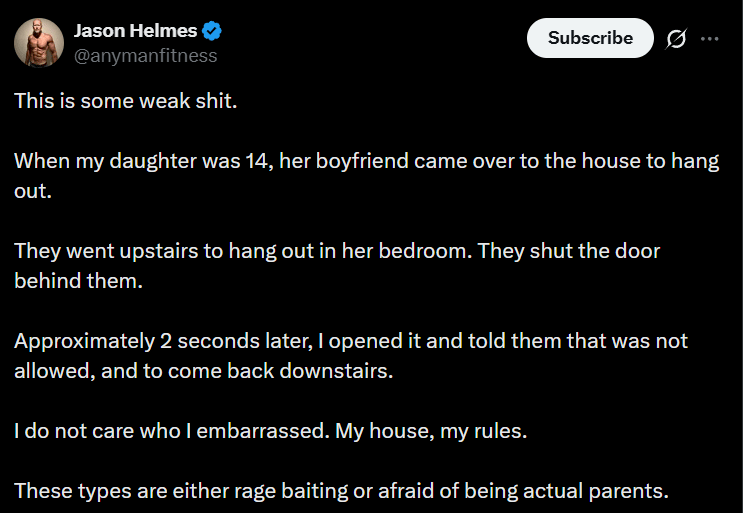
The thread begins with Jason Helmes (@anymanfitness), who recounts an incident involving his daughter when she was 14:
He describes allowing her boyfriend to visit, watching them go upstairs to her bedroom, and then opening the door “approximately two seconds later” to shut it down. He emphasizes that he did not care who he embarrassed, ending with the familiar refrain: “My house, my rules.” He then dismisses critics as either “rage baiting” or “afraid of being actual parents.”
This framing is telling. The focus is not on safety, communication, or age-appropriate boundaries, it’s on humiliation, dominance, and control. The pride taken in embarrassment reveals the real motivation: asserting power, not teaching responsibility.
The Countdown Mentality
The authoritarian tone is reinforced by Oliver (@theoliverxp), who adds:
“This might not be popular but my daughter can have a boyfriend when she’s 18 and not a minute sooner.”
This isn’t protection, it’s ownership. Treating a child’s social and emotional development like a legal switch that flips at midnight on their 18th birthday ignores reality entirely. Teenagers do not suddenly gain judgment, emotional literacy, or boundaries by statute. Those skills are learned gradually, through communication, trust, and guidance, before adulthood.
Freezing normal development until a legal cutoff doesn’t prevent relationships. It only ensures secrecy, dishonesty, and resentment.
Escalation as a Badge of Honor
Others rush in to one-up the display of control.
Zach Browne (@ZachBrowne) boasts:
“They wouldn’t have made it to the stairs in my house lol.”
Meanwhile, Full Contact ODTE (@ChartScience) escalates further, comparing the situation to “lighting your stove on fire,” declaring that someone would be embarrassed whether it involved a daughter or a son.
None of these responses demonstrates parenting skill. They demonstrate fear of sexuality, fear of loss of control, fear of being unable to guide rather than dominate. The constant emphasis on embarrassment as a corrective tool is especially revealing. Shame is not education. It is a shortcut used when communication skills are lacking.
The Only Reasonable Question
Amid the chest thumping, supercollider (@supercollider_x) asks the only sane question in the thread:
“why can’t you let your kids have fun?”
Helmes responds by redefining “fun” in the most reductive way possible, equating any closed-door privacy with sexual misconduct, a projection that says far more about the parent than the child. This kind of thinking teaches teenagers that their parents see them not as people learning boundaries, but as problems to be controlled.
What Healthy Parenting Actually Looks Like
Healthy parenting does not mean unrestricted freedom, nor does it mean naïve permissiveness. It means setting reasonable, transparent, and age-appropriate boundaries while maintaining trust and open communication. It means preparing children for adulthood instead of ruling over them until the moment they legally escape.
Rules that exist solely to assert authority are not discipline; they are narcissism. Parenting that relies on humiliation is not strength; it is insecurity. And calling this behavior “actual parenting” is pure projection.
Final Thought
Quite frankly, the attitudes displayed by Jason Helmes (@anymanfitness), Oliver (@theoliverxp), Zach Browne (@ZachBrowne), and Full Contact ODTE (@ChartScience) reflect emotional immaturity and a need for control that is incompatible with healthy parenting. If this is what they believe leadership over a child looks like, then it’s hard to argue they are fit to be parents at all and it is genuinely sad behavior to see from people who claim to care about their children.



 The Immoral List
Leave a comment